Carole Boyce Davies has rendered a unique service in restoring to proper recognition the life and achievements of the Trinidad-born political activist and feminist Claudia Jones. From the turbulent struggles of Harlem, U.S.A. in the 1930s and 1940s to London in the 1950s and 1960s, Claudia Jones became a symbol of resistance and the standard by which others would measure their own integrity of commitment. Left of Karl Marx is the biography of an era of the most intense ideological combat — where reputations were assassinated and careers erased by a single rumor of incorrect political affiliation. Here is the story of a singular triumph whose legacy has nourished the lives of another generation.
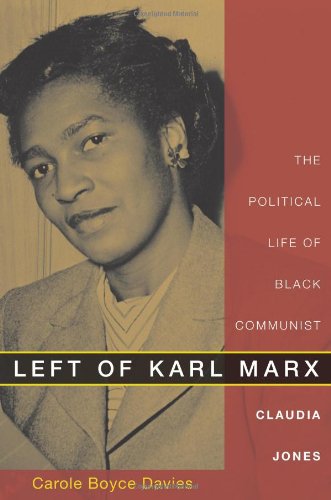
Left of Karl Marx
The Political Life of Black Communist Claudia Jones
In Left of Karl Marx, Carole Boyce Davies assesses the activism, writing, and legacy of Claudia Jones (1915–1964), a pioneering Afro-Caribbean radical intellectual, dedicated communist, and feminist. Jones is buried in London's Highgate Cemetery, to the left of Karl Marx — a location that Boyce Davies finds fitting given how Jones expanded Marxism-Leninism to incorporate gender and race in her political critique and activism.
about the book
Claudia Cumberbatch Jones was born in Trinidad. In 1924, she moved to New York, where she lived for the next thirty years. She was active in the Communist Party from her early twenties onward. A talented writer and speaker, she traveled throughout the United States lecturing and organizing.
In the early 1950s, she wrote a well-known column, "Half the World," for the Daily Worker. As the U.S. government intensified its efforts to prosecute communists, Jones was arrested several times. She served nearly a year in a U.S. prison before being deported and given asylum by Great Britain in 1955.
There she founded The West Indian Gazette and Afro-Asian Caribbean News and the Caribbean Carnival, an annual London festival that continues today as the Notting Hill Carnival.
Publication Details
- Full Title
- Left of Karl Marx: The Political Life of Black Communist Claudia Jones
- Author
- Carole Boyce Davies
- Publisher
- Duke University Press
- Published
- February 2008
- Pages
- 311
- ISBN-10
- 0822341166
- ISBN-13
- 978-0822341161
- Language
- English
what scholars say
Carole Boyce Davies has vividly brought to life the work and struggles of Claudia Jones in the U.S.A. and Great Britain in her new book. Boyce Davies possesses that unique combination of being both a scholarly researcher and a writer capable of clear and persuasive language. The reader is presented with a remarkably readable and informative study of a woman who was equally adept in her writing and public speaking on feminism, and as a social pioneer, a political analyst, and an avowed adversary of racism. This book removes Claudia Jones from the shadow of the great bust of Marx to the front row of the black activists and thinkers of the twentieth century, and that is where she belongs.
This book fills a lacuna in the historical understanding of black left radicalism and socialist-oriented feminism in the United States and the Caribbean. In this era of twenty-first-century corporate globalization, it reunites us with a transnational radical and anti-capitalist past through the examination of the extraordinary life, work, and political philosophy of Claudia Jones. This work reminds us that the U.S. and British radical traditions had diverse memberships, which included black, communist, and feminist women of whom Trinidad-born Claudia Jones was a remarkable example. Carole Boyce Davies has given us a well-researched, detailed analysis of this communist, feminist, intellectual, activist, and artistic woman of Caribbean origin. This is a long-awaited treasure for which many will be eternally grateful.
Carole Boyce makes an important contribution to the history of Caribbean, communist, feminist women, such as Hermie Huiswoud and Grace Campbell, who have tended to figure only at the margins of their male counterparts' political profiles. The work is much more compelling in the chapters where Davies discusses Claudia Jones' deportation, carnival and Diaspora activism, and in her work in the interest of peace… Left of Karl Marx is essential reading for students of the broader Caribbean community.